
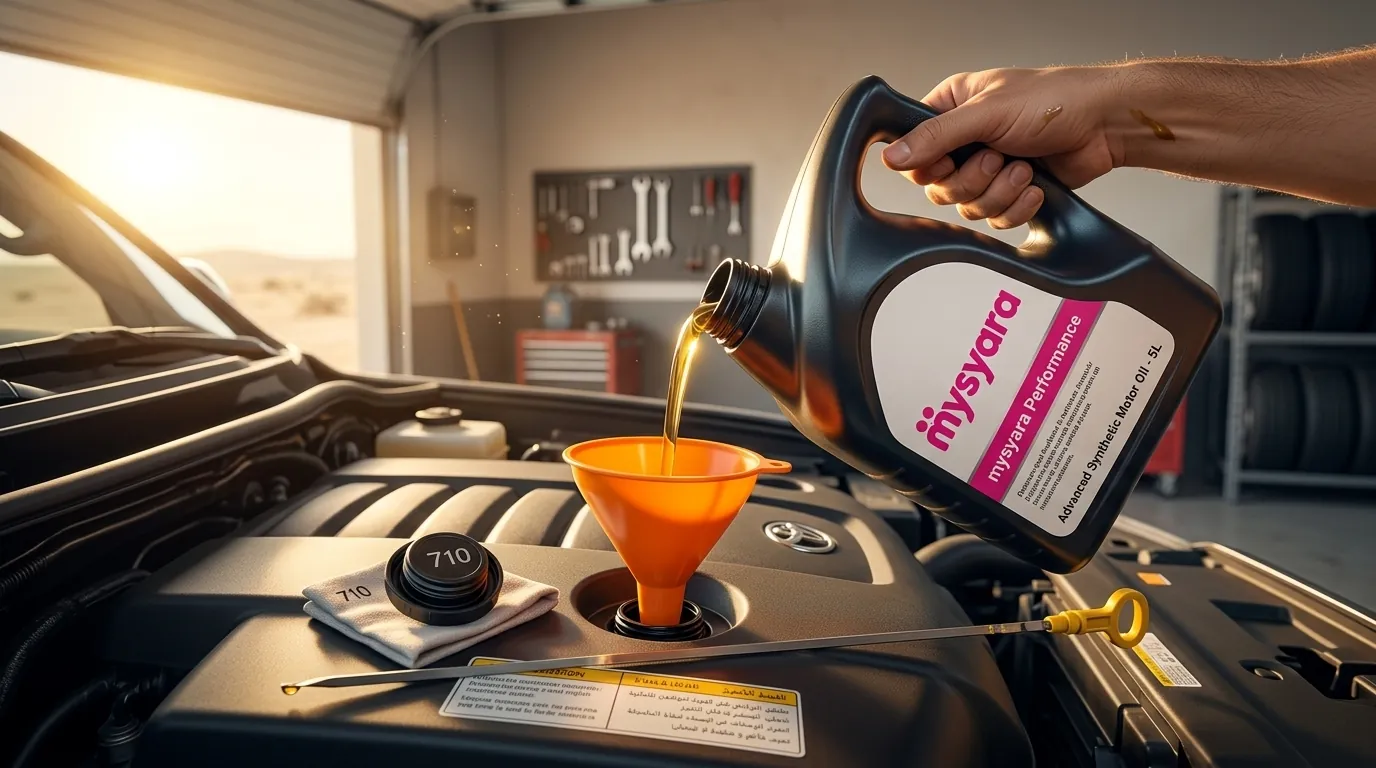
Checking engine oil takes two minutes and a paper towel. It’s the single easiest health check on a car, one line on a wider monthly maintenance routine, and one of the few jobs that genuinely needs no tools, no lift and no workshop. In the UAE the case for doing it regularly is stronger than in cooler countries: heat thins oil faster, summer commutes are unforgiving, and a low-oil engine in 45°C doesn’t last long.
This guide walks through how to check the dipstick, what the level means, and how to read the colour without overthinking it. It also says when to stop topping up and book a service, because the wrong answer to that question costs you an engine.
When to check the oil
Once a month is the right cadence for most cars in the UAE. Add a check before any of the following:
- A long road trip (Hatta, Liwa, RAK, anything Oman-bound).
- A loaded weekend run with a full car and a roof box.
- A return from desert driving (sand sometimes finds its way past seals on older cars).
- After your dashboard pings any oil warning, even an intermittent one.
You can also use any car wash visit as a quiet reminder. While the team works on the exterior, pop the bonnet and run the check.
What you need
- A paper towel or a clean lint-free rag.
- Flat parking, driveway, garage, kerb that is not on a slope.
- Patience to wait 10 minutes after switching the engine off.
That is it. No funnel and no extra oil for the check itself. Keep a litre of the correct grade in the boot if you want to be ready to top up; check the oil filler cap or the owner’s manual for the grade your car needs.
Step-by-step: how to check engine oil
- Park on level ground. A car parked on a slope reads false, low on the high side and high on the low side. The driveway or your usual parking bay is fine if it is flat.
- Switch the engine off and wait. Give it at least 10 minutes if you’ve just driven. Overnight is better. First thing in the morning is the most reliable reading you’ll get. A small number of manufacturers (BMW, for one) specify checking warm with the engine running, so check the manual if your car is one of those.
- Find the dipstick. Open the bonnet. The dipstick is usually a coloured loop or a T-handle: yellow on most Japanese cars, orange or red on Korean cars, black with a coloured ring on European ones. The car manual labels it as “Engine oil” with a wavy line icon. Some newer European models (BMW from around 2005 onwards in particular) have no physical dipstick, the oil level shows on the dashboard instrument cluster when the ignition is on; check your manual if you open the bonnet and cannot find a dipstick handle.
- Pull the dipstick out. Pull straight up. There will be oil on it.
- Wipe it clean. Wipe the whole metal blade with the paper towel. The first pull is splashy and is not a real reading.
- Dip it back in fully. Push the dipstick back into the tube all the way down to where it seats.
- Pull it out again and read. Hold it horizontal so the oil does not run down. The level is where the wet line ends.
- Compare against the two marks. The blade has two marks: a lower one (sometimes “MIN”, sometimes a single dot) and an upper one (“MAX” or a second dot, often with hatching between). The oil should sit somewhere between the two, ideally closer to the upper mark.
That is the whole job. Slot the dipstick back in firmly and close the bonnet.
How to read what you see
| Reading | What it means | What to do |
|---|---|---|
| Between the two marks, closer to upper | Healthy level | Nothing, write the date down, check again in a month |
| Between the two marks, closer to lower | Marginal, burning oil slowly | Top up to the upper mark; check again in two weeks |
| At or just on the lower mark | Low | Top up before the next drive; check the ground under the car for fresh leaks |
| Below the lower mark | Critical | Top up before driving further than the nearest petrol station; book a service |
| Above the upper mark | Overfilled | Drain the excess at a workshop. Overfilled oil foams and aerates, which is harder on the engine than slightly low oil |
What the colour tells you (and what it doesn’t)
Fresh engine oil is the colour of honey or maple syrup. As the engine runs, oil picks up combustion soot and slowly darkens. That’s normal, not a fault. The colour bands roughly read as:
- Honey-amber: fresh, recently changed.
- Light-to-mid brown: normal mid-life oil. Nothing to act on.
- Dark brown: approaching the service interval. Nothing to act on if the service is not yet due.
- Treacle-black or gritty between the fingers: overdue. The oil has lost its protective additives. Book a service rather than top up. Some workshops will offer an engine flush at this point; that’s reasonable if you’re switching from mineral to synthetic, but skip it if the oil was simply overdue on a well-maintained engine.
- Milky, foamy, or coffee-with-milk coloured: coolant is mixing with oil. Book a workshop check the same day. This is a head-gasket or oil-cooler issue, not a top-up.
In the UAE, oil darkens faster than in cooler climates because heat and short stop-start trips accelerate the chemistry. Don’t panic at colour alone. Trust the kilometre and time intervals from the service book, and use colour as a supporting signal.
Topping up oil safely
If the level is low, topping up is a five-minute job:
- Buy the correct grade for your car. The most common UAE grades are 5W-30, 5W-40 and 0W-20 (typical for newer Japanese and hybrid models); check the filler cap or the manual to be sure. If the sump was factory-filled with fully synthetic oil, top up with synthetic. Mixing mineral oil into a synthetic sump dilutes the protection. Wrong grade is worse than slightly low oil.
- Unscrew the oil filler cap (the one with an oil-can icon on top of the engine, separate from the dipstick).
- Pour slowly. Add about 250-300 ml at a time, then wait a minute and re-check the dipstick. Engines hold more than you think. Adding a litre at once almost always overfills.
- When the dipstick reads at the upper mark, stop. Refit the filler cap firmly. Wipe up any spill on the engine cover. Oil bakes onto hot exhausts and smells.
If you are topping up every couple of weeks, the car is telling you something. A monthly top-up is within normal-burn range for older or high-mileage engines, but anything more frequent usually points to a leak or internal burn that deserves a workshop look. Treat the top-up as a stopgap, not a strategy.
When to book a service instead
Some readings are not a top-up moment. Stop adding oil and book a service if any of the following applies:
- The oil is milky, foamy, or any other colour than amber/brown. That’s coolant mixing or contamination.
- You’ve topped up twice in a month and the level keeps dropping.
- A fresh oil spot under the parked car is getting bigger over time.
- The oil pressure light, oil-can icon, or any “service engine soon” warning has come on, even intermittently.
- The car is at or beyond its service interval anyway. The right answer is the service, not another top-up.
For Dubai customers, a doorstep mechanic can come to your address for an at-home oil top-up or a quick check: pop the bonnet, look at the dipstick, and tell you whether you can wait until the next scheduled service or book sooner. For a full oil change, a workshop is the right surface. The car needs to be lifted to drain the sump cleanly, which isn’t a kerbside job. Workshop service runs across Dubai, Abu Dhabi, Sharjah and Ajman.
Ready when the level says so
Engine oil is the single most informative thing on your car, and a dipstick is the cheapest diagnostic tool you will ever use. A check once a month, top up when the level says so, and book a service when the oil itself or the interval says so. That is the entire discipline.
If you would rather hand the check off, or the dipstick reading is making you uneasy, book a doorstep mechanic for a Dubai address, or a workshop service in Dubai, Abu Dhabi, Sharjah or Ajman. Call us or WhatsApp +971 50 823 7890 if you would rather talk it through first.