
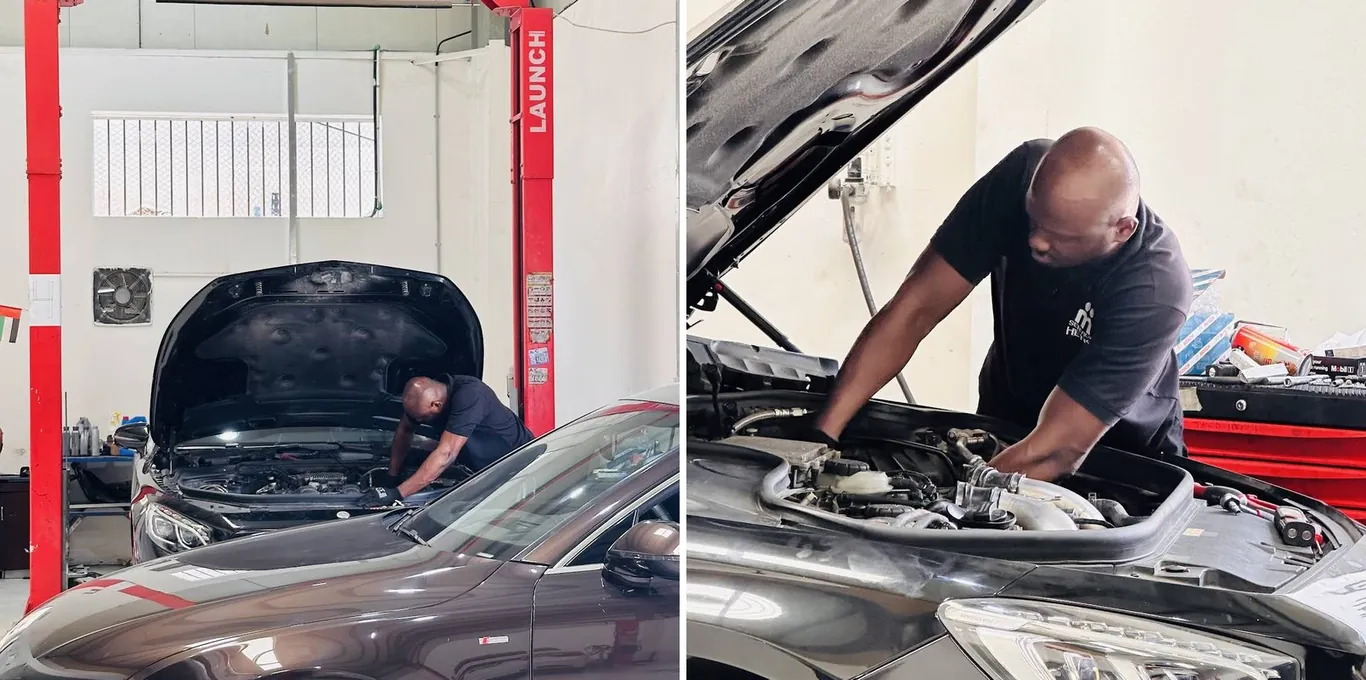
How often should you service your car in the UAE? For most cars, every 10,000 km or six months, whichever comes first. UAE heat, sand and short stop-start trips age your engine oil and filters faster than a cooler climate would, so the shorter interval is the one that matters.
Take Omar, for instance. He runs three cars from his villa in Sharjah (a Land Cruiser, a family Camry and his teenager’s first hatchback), and every one of them falls due at a different time. If you have ever looked at the sticker on your windscreen and wondered whether you have left it too long, this guide sets out a clear cadence: when a full service is due, why UAE driving counts as severe, and how to read the signs before a warning light forces the decision.
The short answer on how often to service your car in the UAE
The honest answer is a band, because cars genuinely differ. But for the large majority of vehicles on UAE roads, a full service every 10,000 km or six months is the sensible cadence. Take whichever of those two you reach first.
Many newer cars are sold with a longer interval printed in the owner’s manual, often 15,000 km or 12 months. That figure is the manufacturer’s normal schedule, and it assumes mild, steady driving. UAE driving is not mild. Between 45°C summers, fine sand, and the short school-run and stop-start commute trips most of us actually do, your car lives much closer to the manual’s severe schedule than its normal one.
So treat 10,000 km or six months as your real-world interval, not the longer number. If your car is already past that mark, you can book a full car service and stop guessing. The rest of this guide explains why the shorter figure is the right call, and how to tell when your own car is due.
Why UAE driving is severe service territory
Every owner’s manual carries two maintenance schedules: a normal one and a severe one. The severe schedule exists for conditions that wear oil, filters and components faster than ordinary driving. It is not a niche category. It covers short trips, frequent stop-and-go traffic, extreme heat and dusty roads.
Read that list again with a UAE commute in mind. The morning crawl on Sheikh Zayed Road is stop-and-go. The drive to drop kids at school and back is a short trip; the engine never fully warms and burns off moisture. Summer tarmac runs far hotter than the manual’s designers assumed. And sand is simply in the air. A UAE car ticks almost every box on the severe list at once.
That has three practical effects. Engine oil thins and degrades faster in sustained heat, so it protects for fewer kilometres. The engine air filter (the one that keeps sand out of the engine) clogs sooner than the book interval suggests. And the battery takes a beating: car batteries in the UAE typically last two to three years, against three to five in cooler climates, because heat evaporates the fluid inside the case.
Consider Khalid. His Pathfinder’s dealer SMS pinged in March; he was busy and decided it could wait. By July the car was running rough on a chalky, overdue oil, and the air filter was packed with dust. The service he finally booked took longer and cost more than the on-time one would have. Deferring a service in UAE conditions is not saving money. It is borrowing against the engine.
A realistic UAE car maintenance checklist and service-interval guide
Think of this as your UAE car maintenance checklist: intervals adjusted for heat and dust that hold for most vehicles on UAE roads. Your owner’s manual is still the final word for your specific car, but use this as a working cadence.
| Service or check | Typical interval | What changes in the UAE |
|---|---|---|
| Full service (oil, oil filter, fluid top-ups, multi-point check) | 10,000 km or 6 months | Take the shorter of the two; heat degrades oil faster |
| Engine air filter | Inspected at each service | Sand clogs it sooner; it often needs changing before the book interval |
| Air-conditioning check | Once a year | Best done in March or April, before the summer load |
| Battery health test | Not on a fixed timer | Test before summer; UAE batteries typically last 2-3 years |
| Brake inspection | At each service | Judged by wear, not a timer; traffic and heat vary the rate |
| Tyres (pressure, tread, age) | Monthly by you; at each service | Heat raises pressure and ages rubber; check tyres when cool |
A “multi-point check” simply means a technician runs a fixed checklist across the car (brakes, suspension, fluids, belts, tyres and lights) and flags anything worn. It is the part of a full service that catches a problem while it is still small.
Omar treats his three cars as one schedule rather than three emergencies. The Land Cruiser and the Camry are on their own six-month clocks; the teenager’s hatchback, driven hard and parked in the sun all day, he checks a little sooner. Booking them in a planned rhythm means he is never caught with two cars overdue in the same week.
How to tell your car is actually due
You usually have four signals, and it pays to act on the earliest rather than wait for the last:
- The windscreen sticker. Most workshops leave one showing the next service date or kilometre figure. It is the simplest reminder. If it is behind you, you are due.
- The dealer or workshop SMS. A prompt, not a nag. Treat it as the start of the booking, not something to clear from your phone.
- The dashboard service light. A spanner symbol or a “service due” message. Helpful, but it is the last warning, not the first.
- The calendar. This is the one drivers miss most. Service is time-based as well as distance-based.
That last point matters more in the UAE than almost anywhere. If you drive very little, it is tempting to think the service can wait until the kilometres add up. They will not. Oil ages by the calendar; heat and short trips degrade it whether the car covers 20,000 km a year or 4,000. A low-mileage car that has gone eight months without a service is overdue, full stop.
Two quick checks you can do yourself between services: look at the engine oil on the dipstick (fresh oil is amber and translucent, tired oil is dark and gritty), and listen for the air-conditioning losing its bite, which often means the cabin filter or the system needs attention. Neither replaces a proper service, but both tell you whether you should bring the booking forward. For more everyday questions, the MySyara FAQ is a good first stop.
Doorstep mechanic or workshop: which job goes where
If you are looking for a car service at home in Dubai, the honest answer depends on the job. Some tasks come to you; others need a workshop lift. Knowing the split saves you time.
A full service belongs in a workshop. The car needs to go up on a lift so a technician can reach the underside, drain the oil cleanly, and run the multi-point inspection properly. Anything the inspection flags as load-bearing or safety-critical (brakes, suspension, steering, the air-conditioning gas system) is workshop work too. Those are not jobs to rush kerbside, and they are not DIY jobs: getting them wrong is dangerous, so they are booking-only by design. Workshop service and repairs are available across Dubai, Abu Dhabi, Sharjah and Ajman, for any make or brand.
A doorstep mechanic handles the in-between jobs (a battery swap, a jump-start, a quick diagnostic scan) at your home or office. Doorstep visits are the convenient option for small, well-defined tasks that crop up between full services. Oil changes belong in a workshop, where the car can be lifted, drained and the used oil disposed of cleanly. A building car park isn’t equipped for any of that. Doorstep mechanic visits are a Dubai service. If the diagnostic turns up something bigger, it becomes a workshop booking.
The simple rule: a full service is a workshop visit; the small maintenance jobs between services can come to you, if you are in Dubai. Mixing the two up, trying to squeeze a full service into a car-park slot, is how things get missed.
What a full car service includes, and what it costs
A full car service in the UAE generally covers:
- An engine oil and oil filter change, with the grade your car is built for
- Fluid checks and top-ups: coolant, brake fluid, washer fluid, power steering where fitted; transmission fluid level checked
- The engine air filter, and the cabin filter, inspected and changed as needed
- Spark plugs inspected, replaced on the major-service schedule for your car
- A multi-point inspection across brakes, suspension, belts, tyres, battery and lights
- A reset of the service indicator and a fresh reminder for the next interval
What it does not include is anything the inspection finds. If a technician spots worn brake pads or a tired battery, that is a separate repair, quoted to you before any work goes ahead and never added silently.
On price, the honest answer is that it depends on the car. A four-cylinder hatchback and a V8 SUV are simply not the same job: different oil volumes, different filters, different parts. A single fixed price quoted across all cars would be wrong for most of them. So rather than print a number that misleads, MySyara prices a full service per car. Tell us the make and model and you get a personalised (automatic) quote for your vehicle, so get a quote before you commit.
Consider Aisha, who keeps a service log in her phone for her Corolla. She cares less about the lowest possible price than about knowing what she is paying for. A clear “here is what is included, here is the quote for your car, here is what we found and what it would cost to fix” is what earns the booking. That transparency is the standard a service should meet. If a quote is vague, ask.
The bottom line on how often to service your car in the UAE
So, how often should you service your car in the UAE? Every 10,000 km or six months, whichever you reach first. Because UAE heat, sand and short trips put your car on the severe end of every maintenance schedule, that shorter interval is the one to plan around. Do not stretch to the longer figure just because the manual allows it elsewhere.
Watch the calendar as closely as the odometer, trust the earliest reminder rather than the last warning light, and keep the small jobs ticking over between full services. Regular car maintenance on a steady rhythm is cheaper to run, safer to drive and worth more when you sell it than a panicked rush job.
If yours is due, or you are no longer sure when it last went in, book a full service and let a workshop give you a straight answer on where your car stands.