
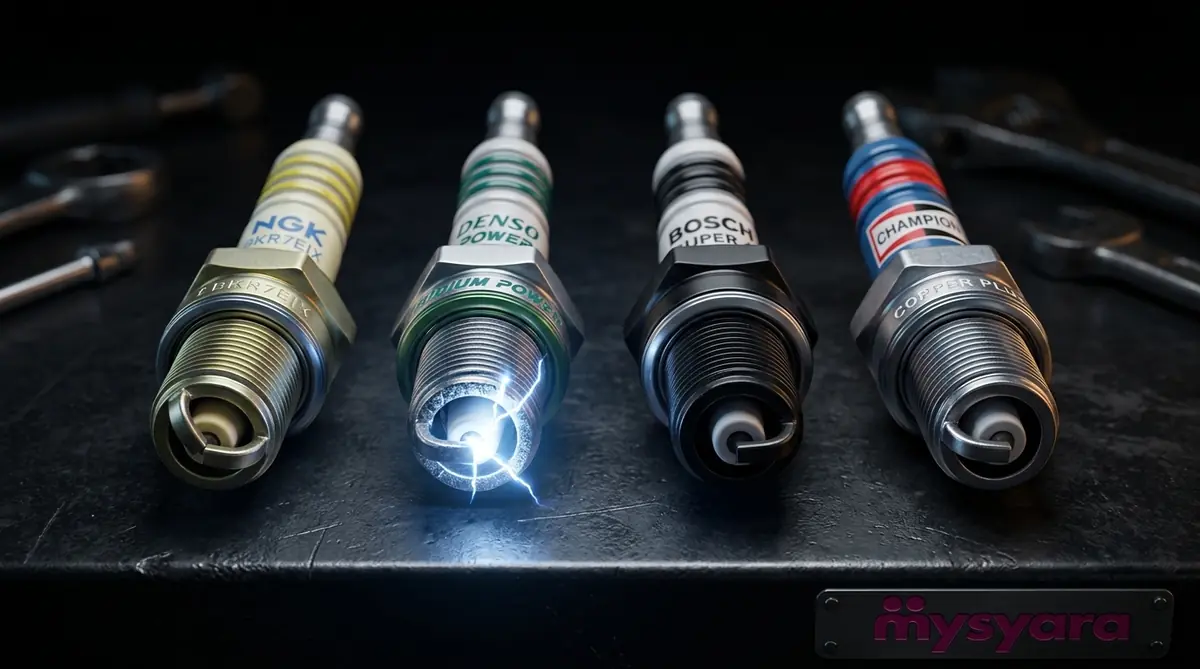
A spark plug does one job: it produces the electrical spark that ignites the fuel-air mixture inside each cylinder. That ignition is what turns petrol into movement. When the plugs wear out, the engine starts to misfire, idle roughly, and use more fuel than it should. Most drivers do not notice until the symptoms have been building for a while, which is why understanding the replacement interval for your plug type is more useful than waiting to feel something wrong.
This guide covers what spark plugs do, the signs they are worn, how long different plug types last, what the replacement involves, and what it costs in the UAE.
What Spark Plugs Actually Do
Each engine cylinder has one spark plug (some performance engines have two, but most road cars have one per cylinder). When the piston compresses the fuel-air mixture at the top of its stroke, the spark plug fires a controlled arc of electricity across a small gap (typically a fraction of a millimetre), and that arc ignites the mixture. The resulting combustion pushes the piston down and powers the drivetrain.
On a four-cylinder engine running at 2,500 rpm, each plug fires around 1,250 times per minute. Across the full engine that is 5,000 firings per minute, every minute the engine runs. The electrodes that produce the arc gradually erode from this constant discharge, and as the gap widens, the spark weakens. At some point the plug starts to miss beats, and the engine tells you about it.
Signs Your Spark Plugs Need Replacing
These are the symptoms worth acting on, roughly in order from earliest to most obvious:
- Rough idle. The engine shakes or feels lumpy when the car is stationary. One or more cylinders are not firing cleanly, so the engine is running unevenly. This is usually the first noticeable sign.
- Hesitation or weak pull-away. Press the accelerator from a standstill or when joining a highway and the car feels sluggish or momentarily hesitates before picking up. Worn plugs cannot produce the consistent ignition the engine needs under load.
- Worse fuel economy. An incomplete burn uses more fuel for the same distance. If your fill-up frequency has crept up without an obvious change in driving, the ignition system is worth checking.
- Slow or reluctant starting. The engine turns over but takes longer than usual to fire. A worn plug delivers a weaker spark at the exact moment the engine needs it most.
- A check-engine or misfire warning light. Modern engines monitor combustion events. If a cylinder misfires, the engine management system will log it and, on most cars, flag it with a warning light.
- Misfiring at idle or under acceleration. The engine stumbles, hesitates, or briefly cuts in and out. Occasional misfires stress the ignition coil (the component that powers the plug) as it compensates, so a worn plug can eventually bring a coil failure along with it.
One symptom on its own is worth monitoring. Two or more together mean the plugs are due for inspection, and likely replacement.
How Long Spark Plugs Last, by Plug Type
The biggest variable is the electrode material. Three types cover most cars on UAE roads:
| Plug type | Approximate interval | Common fit |
|---|---|---|
| Copper | 30,000-50,000 km | Older cars; some performance/sports applications |
| Platinum | Up to ~100,000 km | Many mid-2000s to early 2010s cars |
| Iridium | Up to ~160,000 km | Most modern cars from the mid-2010s onward |
These figures are a guide. Your car’s handbook specifies the interval for your engine, and that number takes priority. Some turbocharged engines run their plugs harder and have shorter intervals than a naturally aspirated engine with the same plug type.
Khalid drives a 2020 Pathfinder. The iridium plugs fitted from the factory could go well past 100,000 km before they need touching, so there is no reason to replace them early. But once he passes that mileage, or if the idle starts to roughen, checking them is the right call rather than letting it run until a coil fails.
Aisha’s 2016 Corolla will have platinum plugs and an interval the handbook specifies, likely around 80,000-100,000 km. At that interval, many owners miss the replacement because the car still drives reasonably well, only noticeably worse once the new plugs go in.
UAE Driving and Spark Plug Wear
The plug material degrades at a broadly consistent rate regardless of climate. UAE driving patterns are worth knowing, though, because they influence how hard the plugs work.
Stop-start city traffic in Dubai or Sharjah keeps the engine running at lower revs for longer stretches, where combustion conditions are less consistent than at cruising speed. Long highway runs at higher speeds (common on the Abu Dhabi to Dubai corridor) load the engine differently. Fuel quality in the UAE meets modern engine standards, so that is not an unusual variable. None of this changes the plug’s material lifespan, but it is a reason to pay attention to the symptoms above rather than purely counting kilometres. If the idle roughens before the interval, check the plugs.
Is Spark Plug Replacement a DIY Job?
On older, simpler engines with easy access to the plug wells, a confident home mechanic can replace spark plugs. On most modern cars, it is a workshop job, and here is why it matters:
The plug type and gap must be exact. Your engine is designed to fire a specific plug at a specific electrode gap (often 0.8-1.1 mm, but it varies by engine). Fitting the wrong plug type (different heat range, wrong thread pitch, mismatched electrode material) can cause misfires, pre-ignition, or damage to the cylinder head. The correct replacement plug is not always obvious from the old one; it comes from the vehicle specification.
Torque matters more than most people expect. Over-tightening a spark plug damages the thread in the aluminium cylinder head, a repair that costs considerably more than a new set of plugs. Under-tightening lets combustion gases leak past. Each plug has a specified torque figure, and fitting them correctly takes a torque wrench.
Access is often not straightforward. On many four-cylinder engines the plugs are accessible once the ignition coils are removed. On others, particularly turbocharged engines, many V6 and V8 configurations, and some transversely mounted engines, the intake manifold or other components have to come off first. On those cars, a spark plug change is an hour-plus workshop job, not a driveway one.
For an enthusiast with the right tools, the manufacturer data, and familiarity with their specific engine, it is a reasonable task. For most UAE car owners, booking it in and having it done with the right parts and torque settings costs a little more than the parts alone and removes the risk of a misfit.
What Spark Plug Replacement Costs in the UAE
MySyara’s workshop service covers spark plug replacement across all four emirates: Dubai, Abu Dhabi, Sharjah, and Ajman.
Every price below is for the complete set of plugs, not per plug. It is tiered by car (the tier reflects the vehicle class and fitment complexity):
| Tier | Price (full set, 4-cylinder) |
|---|---|
| T1 | AED 200 |
| T2 | AED 225 |
| T3 | AED 300 |
| T4 | AED 425 |
These prices cover a set of four Hella or Bosch iridium plugs on a 4-cylinder engine. All four plugs, fitted, not a per-plug rate. V6 and V8 engines use six or eight plugs respectively, so they are quoted separately when you book.
Book through /services/ and you will get a quote for your specific car before you confirm. The system takes the make, model, year, and engine, so the figure you see is for your car, not a generic estimate.
How the Workshop Handles It
When you book a spark plug replacement, the workshop:
- Confirms the correct plug specification for your engine from manufacturer data.
- Removes the ignition coils and any covers or components in the way.
- Removes the old plugs and inspects the condition of each. The wear pattern can indicate whether the engine is running correctly.
- Fits new plugs to the specified torque.
- Reinstalls the coils and any components removed, then starts the engine to confirm all cylinders are firing cleanly.
If the old plugs show signs of oil fouling, heavy carbon deposits, or an unusual wear pattern, the technician can flag it. Sometimes worn plugs are a symptom of a deeper issue (a leaking valve seal, for instance), and it is better to know that at service time than to find out when the new plugs foul quickly.
Book a Spark Plug Replacement
If your car is roughening at idle, hesitating on acceleration, or you are past the interval in your handbook, the plugs are worth checking.
Book a spark plug replacement at a MySyara workshop in Dubai, Abu Dhabi, Sharjah, or Ajman. From AED 200 for a full set of four on a 4-cylinder, exact price confirmed when you select your car. WhatsApp us on +971 50 823 7890 if you would rather talk it through first.